Compute a collection of loss-based and structure-based measures to evaluate the performance of an estimated precision matrix.
Value
A data frame of S3 class "performance", with one row per performance
metric and two columns:
- measure
The name of each performance metric. The reported metrics include: sparsity, Frobenius norm loss, Kullback-Leibler divergence, quadratic norm loss, spectral norm loss, true positive, true negative, false positive, false negative, true positive rate, false positive rate, F1 score, and Matthews correlation coefficient.
- value
The corresponding numeric value.
Details
Let \(\Omega_{p \times p}\) and \(\hat{\Omega}_{p \times p}\) be the reference (true) and estimated precision matrices, respectively, with \(\Sigma = \Omega^{-1}\) being the corresponding covariance matrix. Edges are defined by nonzero off-diagonal entries in the upper triangle of the precision matrices.
Sparsity is treated as a structural summary, while the remaining measures are grouped into loss-based measures, raw confusion-matrix counts, and classification-based (structure-recovery) measures.
"sparsity": Sparsity is computed as the proportion of zero entries among the off-diagonal elements in the upper triangle of \(\hat{\Omega}\).
Loss-based measures:
"Frobenius": Frobenius (Hilbert-Schmidt) norm loss \(= \Vert \Omega - \hat{\Omega} \Vert_F\).
"KL": Kullback-Leibler divergence \(= \mathrm{tr}(\Sigma \hat{\Omega}) - \log\det(\Sigma \hat{\Omega}) - p\).
"quadratic": Quadratic norm loss \(= \Vert \Sigma \hat{\Omega} - I_p \Vert_F^2\).
"spectral": Spectral (operator) norm loss \(= \Vert \Omega - \hat{\Omega} \Vert_{2,2} = e_1\), where \(e_1^2\) is the largest eigenvalue of \((\Omega - \hat{\Omega})^2\).
Confusion-matrix counts:
"TP": True positive \(=\) number of edges in both \(\Omega\) and \(\hat{\Omega}\).
"TN": True negative \(=\) number of edges in neither \(\Omega\) nor \(\hat{\Omega}\).
"FP": False positive \(=\) number of edges in \(\hat{\Omega}\) but not in \(\Omega\).
"FN": False negative \(=\) number of edges in \(\Omega\) but not in \(\hat{\Omega}\).
Classification-based (structure-recovery) measures:
"TPR": True positive rate (TPR), recall, sensitivity \(= \mathrm{TP} / (\mathrm{TP} + \mathrm{FN})\).
"FPR": False positive rate (FPR) \(= \mathrm{FP} / (\mathrm{FP} + \mathrm{TN})\).
"F1": \(F_1\) score \(= 2\,\mathrm{TP} / (2\,\mathrm{TP} + \mathrm{FN} + \mathrm{FP})\)
"MCC": Matthews correlation coefficient (MCC) \(= (\mathrm{TP}\times\mathrm{TN} - \mathrm{FP}\times\mathrm{FN}) / \sqrt{(\mathrm{TP}+\mathrm{FP})(\mathrm{TP}+\mathrm{FN}) (\mathrm{TN}+\mathrm{FP})(\mathrm{TN}+\mathrm{FN})}\)
The following table summarizes the confusion matrix and related rates:
| Predicted Positive | Predicted Negative | |||
| Real Positive (P) | True positive (TP) | False negative (FN) | True positive rate (TPR), recall, sensitivity = TP / P = 1 - FNR | False negative rate (FNR) = FN / P = 1 - TPR |
| Real Negative (N) | False positive (FP) | True negative (TN) | False positive rate (FPR) = FP / N = 1 - TNR | True negative rate (TNR), specificity = TN / N = 1 - FPR |
| Positive predictive value (PPV), precision = TP / (TP + FP) = 1 - FDR | False omission rate (FOR) = FN / (TN + FN) = 1 - NPV | |||
| False discovery rate (FDR) = FP / (TP + FP) = 1 - PPV | Negative predictive value (NPV) = TN / (TN + FN) = 1 - FOR |
Examples
library(grasps)
## reproducibility for everything
set.seed(1234)
## block-structured precision matrix based on SBM
sim <- gen_prec_sbm(p = 30, K = 3,
within.prob = 0.25, between.prob = 0.05,
weight.dists = list("gamma", "unif"),
weight.paras = list(c(shape = 20, rate = 10),
c(min = 0, max = 5)),
cond.target = 100)
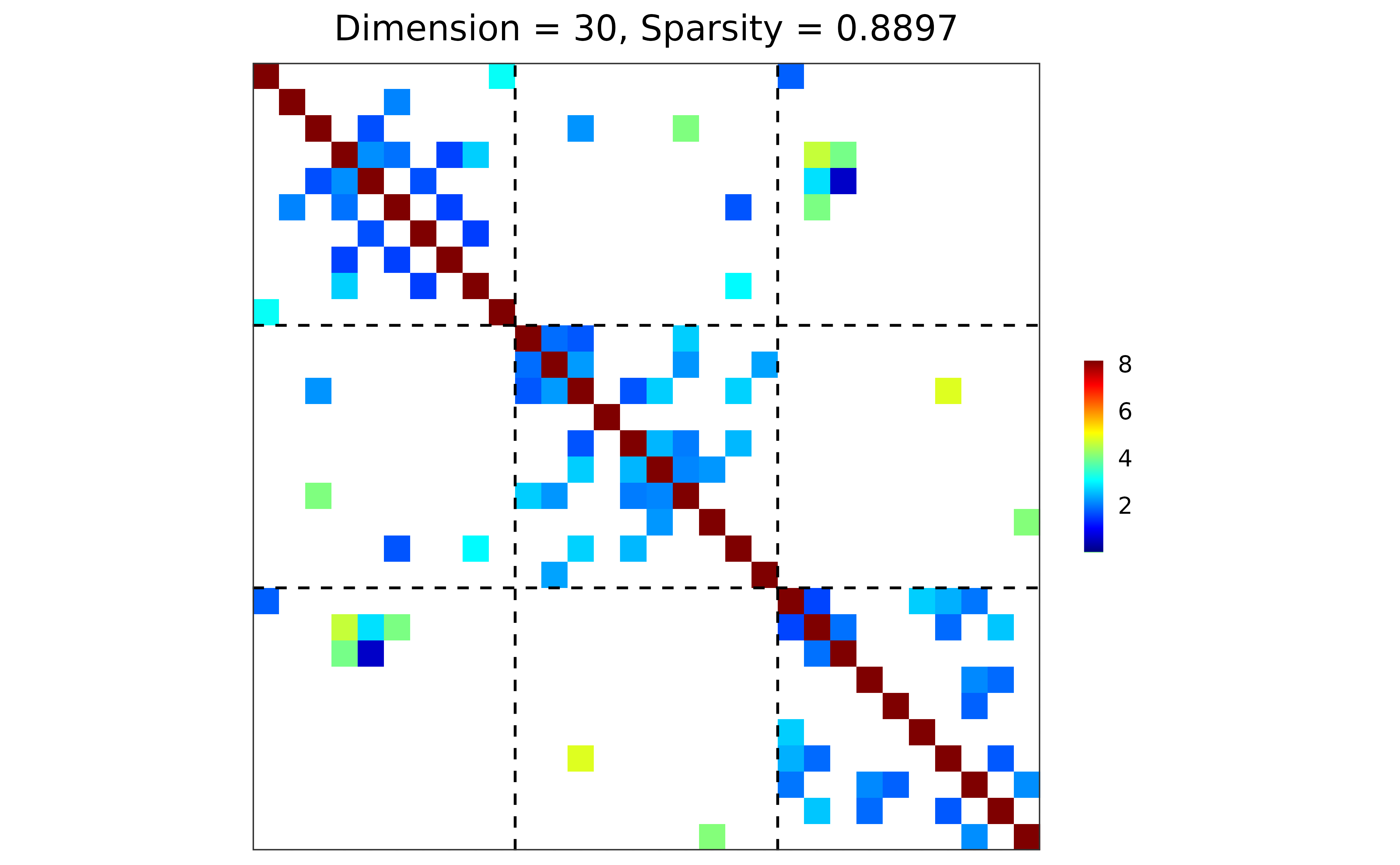
## ground truth visualization
plot(sim)
 ## n-by-p data matrix
library(MASS)
X <- mvrnorm(n = 20, mu = rep(0, 30), Sigma = sim$Sigma)
## precision matrix: adaptive lasso; BIC
prec <- grasps(X = X, membership = sim$membership, penalty = "adapt", crit = "BIC")
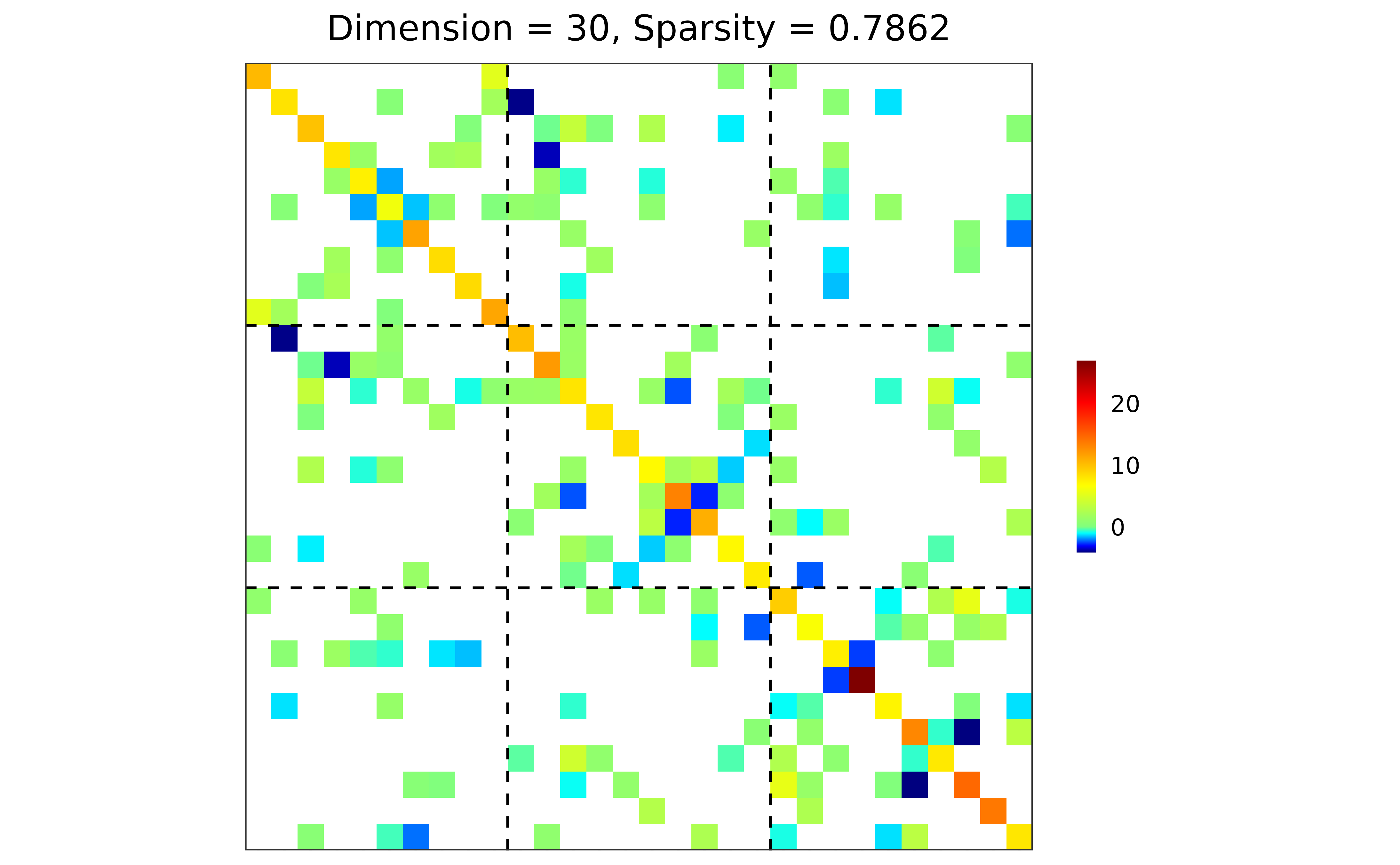
## precision matrix visualization
plot(prec)
## n-by-p data matrix
library(MASS)
X <- mvrnorm(n = 20, mu = rep(0, 30), Sigma = sim$Sigma)
## precision matrix: adaptive lasso; BIC
prec <- grasps(X = X, membership = sim$membership, penalty = "adapt", crit = "BIC")
## precision matrix visualization
plot(prec)
 ## performance
performance(hatOmega = prec$hatOmega, Omega = sim$Omega)
#> measure value
#> 1 sparsity 0.8138
#> 2 Frobenius 27.0344
#> 3 KL 9.9220
#> 4 quadratic 168.3812
#> 5 spectral 12.0472
#> 6 TP 27.0000
#> 7 TN 333.0000
#> 8 FP 54.0000
#> 9 FN 21.0000
#> 10 TPR 0.5625
#> 11 FPR 0.1395
#> 12 F1 0.4186
#> 13 MCC 0.3404
## adjacency matrix: diagonal = 0; raw partial correlations;
## no thresholding; weighted network
adj <- prec_to_adj(prec$hatOmega,
diag.zero = TRUE, absolute = FALSE,
threshold = NULL, weighted = TRUE)
## adjacency matrix visualization
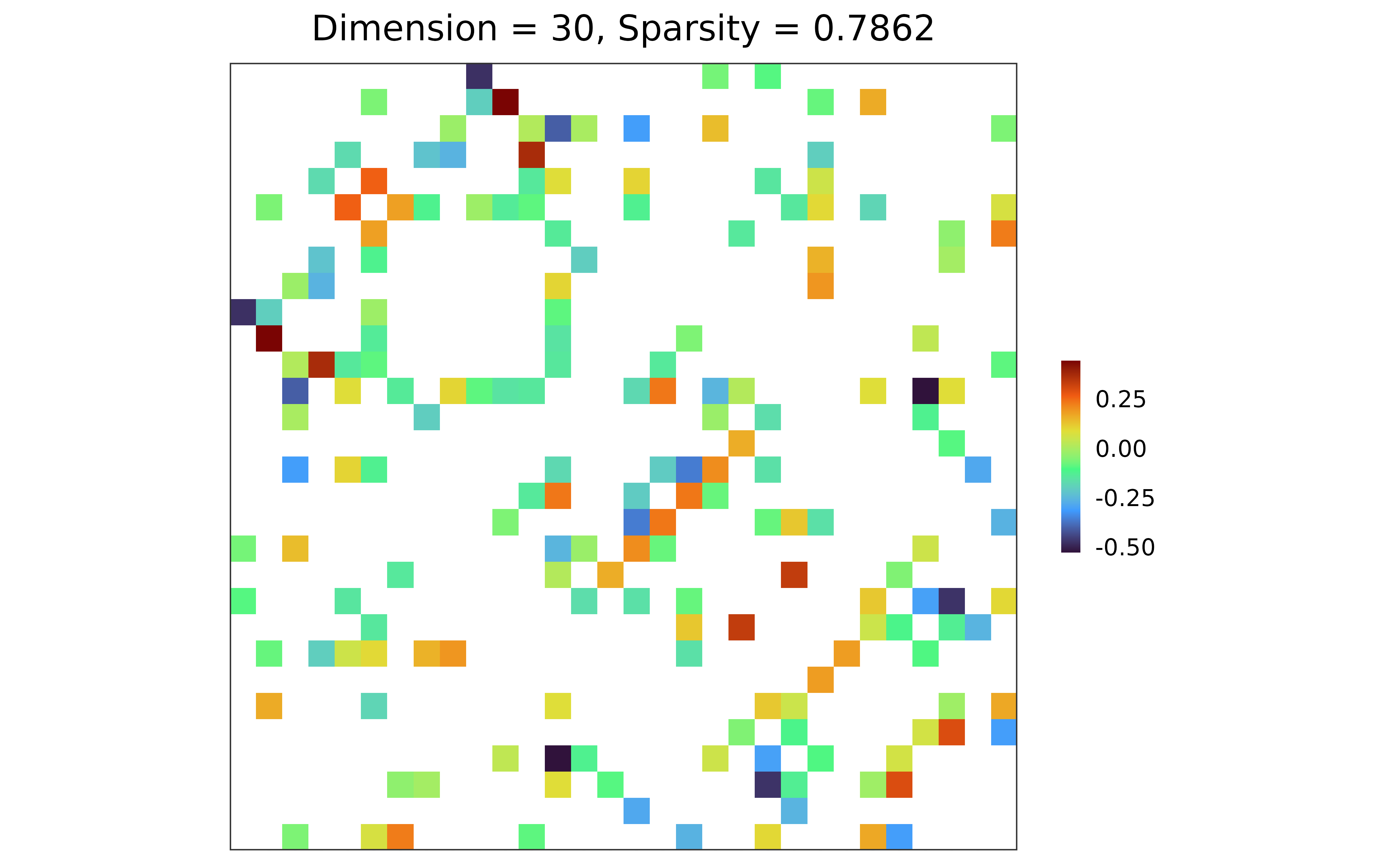
plot(adj)
## performance
performance(hatOmega = prec$hatOmega, Omega = sim$Omega)
#> measure value
#> 1 sparsity 0.8138
#> 2 Frobenius 27.0344
#> 3 KL 9.9220
#> 4 quadratic 168.3812
#> 5 spectral 12.0472
#> 6 TP 27.0000
#> 7 TN 333.0000
#> 8 FP 54.0000
#> 9 FN 21.0000
#> 10 TPR 0.5625
#> 11 FPR 0.1395
#> 12 F1 0.4186
#> 13 MCC 0.3404
## adjacency matrix: diagonal = 0; raw partial correlations;
## no thresholding; weighted network
adj <- prec_to_adj(prec$hatOmega,
diag.zero = TRUE, absolute = FALSE,
threshold = NULL, weighted = TRUE)
## adjacency matrix visualization
plot(adj)